Quarantine in colonial Durban
Our house sits upslope in Glenmore overlooking the Durban
harbour, the Bluff and the Indian Ocean.
During the Covid-19 hard lockdown last year, I would look out to the
Bluff and think about my great-grandfather, Fred Harwin. In early 1874 he was quarantined for two
weeks, along with his father Richard Harwin and his siblings, at the lazaretto
(quarantine station) on the harbour side of the Bluff. The Covid lockdown presented the perfect
opportunity to tell their story, especially as I had recently acquired a transcript
of Richard Harwin’s diary that covers part of their journey by sea and most of
their stay at the lazaretto. However, as
life returned to a semblance of normality when the economy opened up, I never got
around to it. Yet the story persists in
my head, waiting to be written. So, with some encouragement from my Harwin
relatives, here is the first of what I hope will be many ancestral stories.
Our colonial quarantine story starts in 1873 in Feltwell,
Norfolk where Richard Harwin, a Master Butcher, was living with his wife Emma and
their five children. The eldest two,
Fanny and Harry, were from his first marriage to Phoebe Gathercole who died in
1860. Following his marriage to Emma
Cutting in 1864, three more sons, William, Albert and Fred, were added to the
family. Emma had been in poor health for
some time, prompting Richard to plan to emigrate to the colony of Natal, South
Africa, in the hopes that the milder climate would be beneficial to her. Richard’s brother, John and wife Eliza (Emma’s
sister), were already settled in Pietermaritzburg, as were two other sisters,
Anna and Nellie. No doubt Richard’s plans
were supported by his brother and other relatives who had lived in the colony
for some time. Richard duly booked their
passage on the steamship ‘Windsor Castle’, set to depart in November 1873.
 |
| 1871 England Census - Richard Harwin and family |
Sadly, Emma was never to experience life here, as she died that October. However, before her death she persuaded Richard to continue with their plans and to entrust the care of the younger boys to her sister, Anna. And so, the heartbroken Richard set sail as planned with his five children, Fanny (17), Harry (15), William (7), Albert (5) and Fred (3)[1], arriving in Cape Town in mid-December. The extract of Richard’s diary starts at this point, detailing the family’s experiences during their short stay in Cape Town. It can’t have been easy for Richard not having his wife’s support to parent their young boys. On Friday 19 December, Richard writes[2]:
After breakfast, we dressed
the dear boys and went into town for the day. Little Fred began to cry as soon
as we got through the dock gates, and said he wanted to go home.
From Cape Town, the Windsor Castle headed for Port Elizabeth,
where six days later, on 26 December, the family was transferred to the much
smaller coaster, the ‘Kaffir’. This was
done a mile out to sea, by lowering the passengers in a basket into a boat
which took them to the coaster, a distressing experience for the whole family.
My three boys and myself first
were bundled into a basket, then Fanny and Harry and others, the Boat being too
full and the sea rough, the Boat bumping against the side of the Ship. It would
have frightened the stoutest heart. The sailors themselves saying, we must go
down… The dear boys and ourselves in a miserable plight and the sea breaking
quite over us. We were all either ill or sick. The sea as such, the Boat
would not return for the remainder of our Luggage, which was left behind to our
great Inconvenience, not having many things we require most…
The remainder of the trip to Durban was difficult for the
family. Firstly, the ship was overcrowded, so the men had to sleep on the
tables, the sleeping berths being reserved for women and children, until the ship
reached East London two days later and some passengers disembarked. Then, a day into the trip, “poor little Freddy
was taken so ill, myself and Fanny had to be constantly by his side”. Fred had
measles with a bad fever. The ship’s
doctor prescribed treatment, and once the spots appeared, he “took a turn for
the better”.
 |
| Fred Harwin in 1878 |
On 30 December, the ship arrived at Durban, as described by Richard:
... we went up to deck for air
about 4 a.m. and saw the Natal lights which made us all rejoice. We reached the
outside of the Bar at 7 a.m. all pleased, packing up ready for landing, but we
were again disappointed having to anchor outside for two days, the Bar being
too rough to cross … little Freddy getting better and spots disappearing these
two days.
At this point all seemed well, and the family were clearly
looking forward to getting off the ship and being reunited with their
Pietermaritzburg family.
But this was not to be. Quarantine regulations were strictly
enforced in Durban.[3] Measles
was a serious disease at the time – the country had experienced a couple of severe
measles epidemics in 1839 and 1860-61. Other diseases of concern included small pox,
whooping cough, and cholera. In 1860, in
anticipation of the arrival of the first indentured labourers from India, the
Natal Government selected a site on the Bay side of the Bluff for a lazaretto[4]. Construction had commenced when the ship ‘Belvidere',
arrived towards the end of 1860 with a cholera epidemic on board (24 passengers
had already died). Great consternation
ensued about the location of the lazaretto on a busy section of the Bay, so
instead a quarantine camp (wattle and daub huts covered with old sails) was set
up at the back of the Bluff to cater for the Belvidere immigrants. 'Mr Milne’s tram line' was used to transport supplies
and water to the terminus opposite Cave Rock.
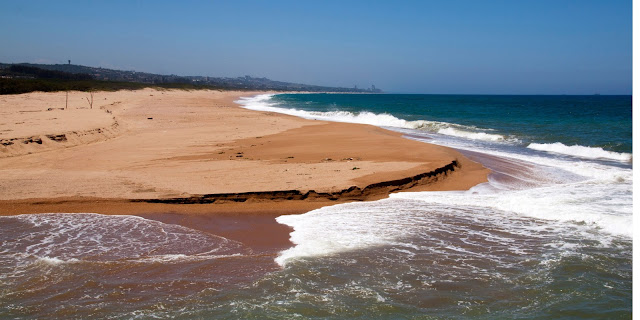
The quarantine camp was situated on an open sandy site nearby accessed by
a “rough-hewn goat’s path over the sharp rocks”[5].
It would appear that when the Harwins arrived in early 1874,
the quarantine situation was unchanged. It was only in July 1874 that the construction
of a permanent quarantine station was completed on the seaward side of the
Bluff[6].
This after pressure from the Mayor following the arrival earlier that year of
the ship ‘Blenheim’ from India with cholera once again on board.
Now back to the Harwins, who on 2 January 1874 were waiting
to disembark. Richard’s brother John had
come to the ship to meet with him, when Richard received the dreaded order from
the government doctor that the family must go to the lazaretto for a few days. William
Harwin’s memoirs[7] confirm
that the family was quarantined in the original lazaretto on the Bay side of
the Bluff:
… the whole family was
quarantined on the Bluff, where we remained for 2 weeks, in the old Lazaretto
on the town side of the Bluff, more or less where the coal-loading wharves are
today. The old weather-beaten building was demolished in 1900.
Richard records in his diary,
No one can tell the disappointment
and dread I had come over me, not being allowed to dress the child. I wrapped
him up in my rug and blanket and we all proceeded to this place. I will not
exaggerate but such a place would be despised by the poorest class in England.
There are windows, but broken doors in such a state … that we could not lock
them, large timbers laid to sit upon, and not an article of furniture of any
sort. When we landed in this hovel we all, the dear children too, had a
heart-breaking cry one against the other …
The requirement to quarantine must have been overwhelming
for Richard, at the end of a long sea voyage, and who was still grieving the
loss of his wife. He was likely doubting
whether his decision to bring his children to Natal was the right one. But he
managed to rally and headed back to the ship, paying a man to take him by boat. He complained to the Captain, who berated him
for leaving the lazaretto. Richard’s response was “that was my last thought. I
would protect my dear Motherless Children”. The Captain insisted that he return
to the lazaretto, and promised provisions, which duly arrived a little later
along with a pot and rudimentary utensils. Further provisions and furniture were
sent in the evening (probably by the government), together with ‘an Englishman’
and two Zulu servants to support them.
The Harwin family was required to quarantine for two weeks,
despite Freddy’s mild case of measles and Richard’s appeals to the doctor on 5
January, as described in his diary:
Soon the Doctor came and
enquired how we were getting on. I said we all felt it very hard to be here and
my daughter fretted very much, it almost induced me to get away. He abruptly
said if I did, I was under penalty of £100. I then said I hope you
will not keep us many more days. He gave me the paper of rules which notified
15 days after the recovery of contagious diseases, which when he said we must
stay the time, which again grieved me. I informed him that it was in his power
to mitigate the time, under the circumstances. He asked me if I wished the
people measles. I said Certainly Not … He said he must do his duty.
The location of the lazaretto on Durban’s bay had certain
advantages. From son William’s perspective,
their quarantine experience was “quite an adventure”, and that “we children had
a happy time fishing and bathing”. Richard writes about how, on a very hot day, “I
let the boys bathe together, it made us laugh to see little Fred lay down in the
water, they are all well and hearty, I think it does them good…” While the young boys were happy enough, they
still often asked their father “when are we going to leave here and see
Aunties, Uncles and Cousins”. For Fanny,
who was already a young woman, the experience was not a happy one. Richard wrote
how “Fanny frets very much, poor girl, it grieves me to the heart to see her.
Could I ever of entertained this would be, I would not have left my English
Home, but we must hope on”.
Richard’s anxieties for his family were numerous, especially
for their safety. A knock on the door at
midnight on their first night at the lazaretto caused much alarm. The man claimed to be searching for the chief
steward of a ship who had jumped overboard, but Richard suspected him of being
a robber. A week into their stay, he pens
his anxieties:
I often think what would my
friends in England feel if they knew we were in such a wild place hearing the
monkeys chatter around them on one side and seeing large sharks coming close to
shore and hearing rats running about the place at night … There is no running away
here for there is the sea on one side and the Bluff on the other side, no
getting away without a boat. I often awake at night and frighten myself with
the thought as we are not provided with a fire arm which was promised at first,
beside if any of us were taken ill in the night, we might die before any one
could be signalled; this is worse than a gaol to my imagination. I pray we may
soon have freedom again.
 |
| Richard Harwin later in life |
A few days later in the early hours of the morning, wild cats came into the camp, causing sleepless nights for Richard:
… we distinctly heard
leopards and tigers wander about, one jumped up to the door catch and made it
rattle tremendously. The evening before being heavy rain, we could distinctly
see the footprints of many all round about the place … so I cannot but seldom
sleep at night, but sleep in the daytime.
Another of Richard’s concerns was sufficient food for his
family. Following the initial food
supplies provided by the ship, provisions were sent on regular basis by the
government (on the doctor’s orders) and by a Mr R. Harwin (presumably a
relative). Customs checked everything that was sent to them. A further ‘spanner in the works’ presented
itself when the wife and two children of ‘the Englishman’ came to join him for
the duration of their stay. Apart from
adding mouths to feed, Richard complained that the wife was “most wasteful and
extravagant”. When new provisions arrived, he said they “have to look very
sharp or they would be wasted in a few hours by this family”.
A week into their stay at the lazaretto, the food ran very low, causing
some anxiety:
We have been
anxiously looking for the provision boat, had a scanty breakfast, no bread,
some cake baked in the frying plan, for dinner only sugar and coffee, and a few
current dumplings and potatoes, none of us having more than half of what we require
… This is the first time in my life not to have sufficient food. The dear boys
asking for more.
Eventually that evening, Mr Harwin’s
son came over with some bread and butter, and another delivery the following
day. This was received with much excitement: “we were all so pleased, the
children shouting BOAT, BOAT, which brought us supplies for three days”.
Another of Richard’s concerns was the lack of routine and its
impact on his children’s education. He
tried to create some semblance of routine, through evening prayers and encouraging
them to read. He wrote in his diary, “I
feel grieved when I think of the habits they are getting in this place”. On
their first Sunday, the family “climbed the mountain into the bush and read the
Church services and sang hymns as well we could”. A few days later, he wrote:
… the children, they are
happy, but we are far from it, the dear boys being such a time from school and
being miserable with these children, not very clean and not taught well. I try
to get them to read, but it seems almost impossible to detain them.
The diary transcript ends on Monday 12 January, a few days
short of their release from the lazaretto. Unfortunately, we are not privy to
Richard’s thoughts and feelings as they finally set foot in Durban. Later in life, son William wrote in his memoirs,
“After release from quarantine, we crossed to the Point, and a few days later
left Durban by bus [horse-bus] for Pietermaritzburg”. It must have been a joyous occasion for Richard
and the children to be reunited with his brother John and the rest of the family
at last.
As I reflect on Richard’s account of the family’s time in
quarantine, especially his anxieties as a parent, there are several parallels
with what parents are facing today during the Covid-19 pandemic. These include adjusting to a new way of life
in lockdown, concerns about its impact on our children’s education and social
interaction, and for some, the very real anxieties of having sufficient food. Family diaries like Richard Harwin’s are a
precious resource, giving us a window into the real lived experiences and emotions
of our ancestors. They add life to the
bare bones of the limited information we have about those who have gone before
us – the names, dates and places, but not much else.
With thanks to my mother's cousins, Nette Miller, Jenny Duckworth, Barbara Stirton and Digby Howarth for sharing the valuable family records and photographs that contributed to this post.
[1] Ages are based on the March 1871 England
census.
[2] Transcript of Richard Harwin’s diary,
19 December 1873 to 12 January 1874. All indented quotes are from his diary.
[3] Brain, J.B. 1985. Health and Disease
in White Settlers in Colonial Natal, Natalia vol 15, © Natal Society
Foundation, 2010.
[5] Russell, G. 1899. History of Old
Durban.
[6] Bjorvig, A.C. 1979. The History of
the Durban Town Council. 1854 – 1879. Academic thesis presented for the degree of
M.A. University of the Free State.
[7] William Harwin’s short two page memoirs,
probably written in the 1940s.
Comments
Post a Comment